
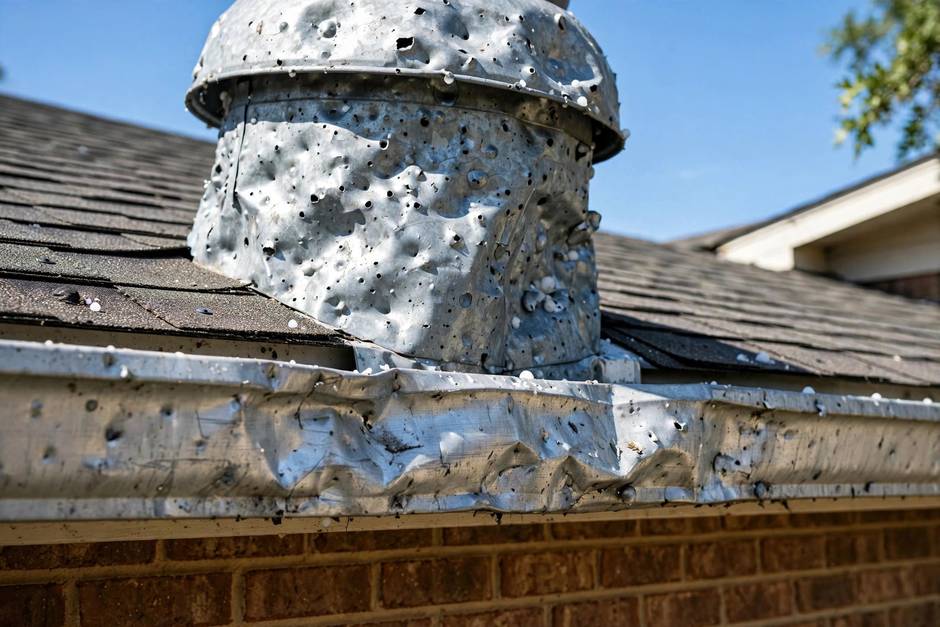
What hail damage looks like
Hail damage on asphalt shingles is usually bruising, not holes. A hailstone crushes the mat under the granules, leaving a soft, spongy spot that may look almost normal from the ground. Around the bruise you will often see granules knocked off in a round patch, exposing the black mat underneath. On older, brittle shingles the same impact cracks or splits the shingle instead. Dented metal is the most visible clue: check roof vents, flashing, gutters, downspouts and the air-conditioning condenser. If the metal is dented, the shingles took hits too.
Damage is not guaranteed at any size, and no single threshold is settled science for a live page: installer guidance summarising lab tests suggests damage to older 3-tab shingles can start around 1-inch hail, with laminated architectural shingles holding up to larger stones. Treat those as rules of thumb, not promises. What matters is the combination — stone size, wind driving the hail, and the age and condition of your shingles.
The 26 April 2026 storm, and why dates matter
The most recent large hail near Duncanville fell on 26 April 2026, when 3-inch hail was reported around Cockrell Hill and Lakeview, as close as about a mile from Duncanville, with 1-inch hail reported in Duncanville itself. Before that, 12 June 2023 brought 4-inch hail to Cedar Hill, about 6 miles away, with 2-inch hail in Duncanville. Within 10 miles of the city there have been 51 hail days since 2006, and 41 produced hail of at least one inch.
Dates matter because an insurance claim needs a date of loss, and because hail damage ages: a bruise made in April can become a leak by autumn as the fractured shingle works loose. If your roof was hit in one of these storms, the inspection should record the storm date alongside the damage.
A documentation checklist
Before any repair, work through this checklist. It is the same discipline a storm-damage inspection should produce, and it protects you whether or not you file a claim.
- Photograph from the ground first. Shingle pieces in the yard, granules in the gutters, dented gutters and vents, cracked skylights. Include a wide shot of the house so the location is clear.
- Note the storm date and size. Write down when the storm hit and what size hail was reported near you. Hail can hit one street and miss the next, so your own observations count.
- Check the attic. Look for daylight through the decking, damp insulation and new stains on the underside of the deck. Do this in daylight, from the attic floor — never step on ceiling joists or wet decking.
- Get a written inspection. A professional inspection should give you dated photos, measurements and a written scope. Keep it with your storm photos.
- Do not sign anything at the door. Door-to-door roofing solicitation in Duncanville requires a police-issued solicitor permit and a reflective vest with badge, and soliciting is not permitted between 7 p.m. and 9 a.m. or on six listed holidays. Texas door-to-door sales also carry a three-business-day cancellation right.
Our hail damage roof repair page explains what an inspection produces, and our hailstorm signs guide covers the ground-level checks in more detail. For the legal boundary, remember: a roofer may inspect, document and estimate, and may meet the adjuster, but may not act on your behalf with your insurer, and you must pay your own deductible under Texas law.
Repair or replace after hail?
That decision turns on how much of the roof is bruised and how old it is. Scattered bruises on a younger roof may be a repair scope; widespread bruising on an older roof usually is not, because the remaining shingles are the same age and the same brittleness. A written inspection that counts the damage by slope is what makes the call honest. If you need that inspection, call (469) 898-7253 to arrange one, and see our roof inspection page for what it covers.