
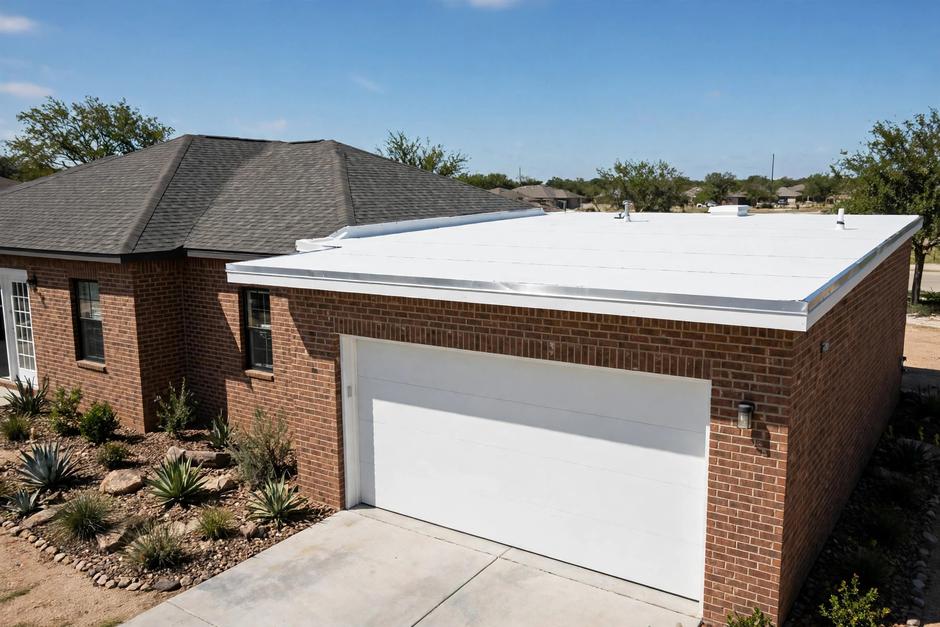
Flat roofs fail differently
Most Duncanville homes have pitched shingle roofs, but flat and low-slope sections are common over garages, additions and porches — and the garage flat roof in one Duncanville review was the job that needed doing. A flat roof does not fail the way a pitched roof fails. Water does not run off; it has to be drained. The failure modes are ponding water, open seams, membrane punctures and failed flashing around drains and penetrations. The roofing code defines ponding as water still standing 48 hours after rainfall, and the industry standard treats ponding beyond 48 hours as detrimental to the assembly. Drainage is therefore the first design question, before any material choice.
Duncanville rain makes the point: annual precipitation at DFW Airport averages 37.01 inches, May is the wettest month at 4.78 inches, and the rain arrives in short violent bursts. A drainage system sized for gentle rain is overwhelmed by a May downpour, and a low-slope roof with nowhere for the water to go will find the weak seam.
TPO, EPDM and modified bitumen compared
TPO (thermoplastic polyolefin). A single-ply white membrane, heat-welded at the seams. Its reflective surface suits Texas heat, and welded seams are strong when done correctly. Third-party DFW ranges put TPO at $5–$13.80 per square foot installed. Lifespans of 20–30 years are quoted in DFW commercial sources.
EPDM (rubber membrane). A black single-ply rubber membrane, usually adhered or ballasted, with taped or glued seams. It is proven over decades and generally cheaper upfront than TPO. DFW ranges put EPDM at $4.60–$11.50 per square foot. Its dark surface absorbs more heat, which matters on a sun-exposed Duncanville roof.
Modified bitumen. Asphalt-based rolls, torch-applied or cold-adhered, in multiple plies. It is the most familiar flat system to many roofers and handles foot traffic well. Its published range is the widest of the three — $4.61–$17.25 per square foot — because torch-down, cold-adhesive and ply-count scopes are bundled under one name. Do not compare a modified bitumen quote with a TPO quote until you know which scope each one is.
All three ranges are third-party DFW market data, not this business’s prices, and all carry 2026 dates. See our flat roofing page for how these systems are installed and inspected.
Drainage first, material second
Before choosing a membrane, answer the drainage questions: where does water go, how fast, and what happens when a drain blocks? Ponding points to blocked drains, crushed or saturated insulation, deck deflection, or too little slope from the start. The code minimum slope for new low-slope construction is a quarter inch per foot. On an existing flat roof, the practical test is the 48-hour check after a storm: if water is still standing two days later, the drainage is not working, whatever the membrane is.
Foot traffic matters too. A flat roof over a garage gets walked on for maintenance, holiday lights and the occasional dropped tool, and punctures are a leading leak source. If your flat section gets regular foot traffic, say so before the material is chosen — it changes the recommendation. For the commercial buyer’s version of this decision, see our companion guide, TPO vs EPDM for your Duncanville business. To arrange an inspection of a flat section, call (469) 898-7253.